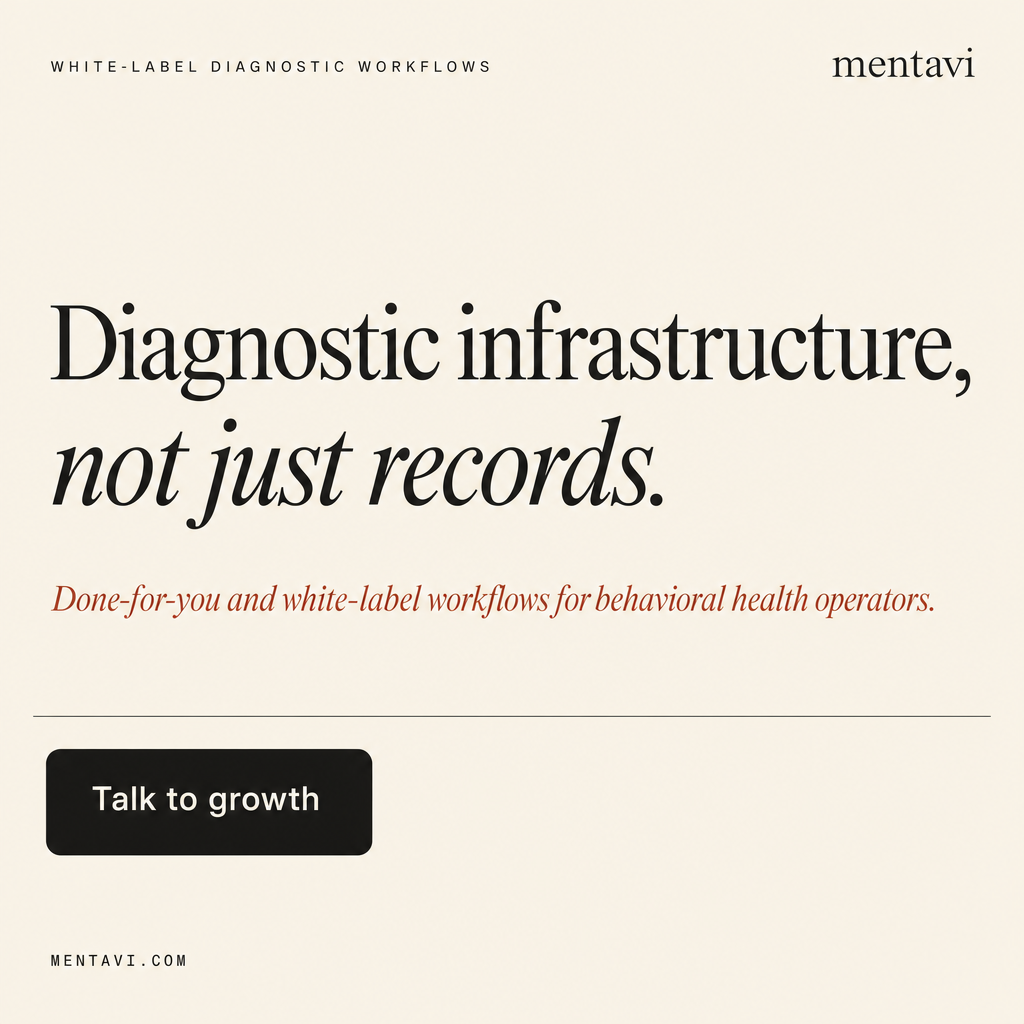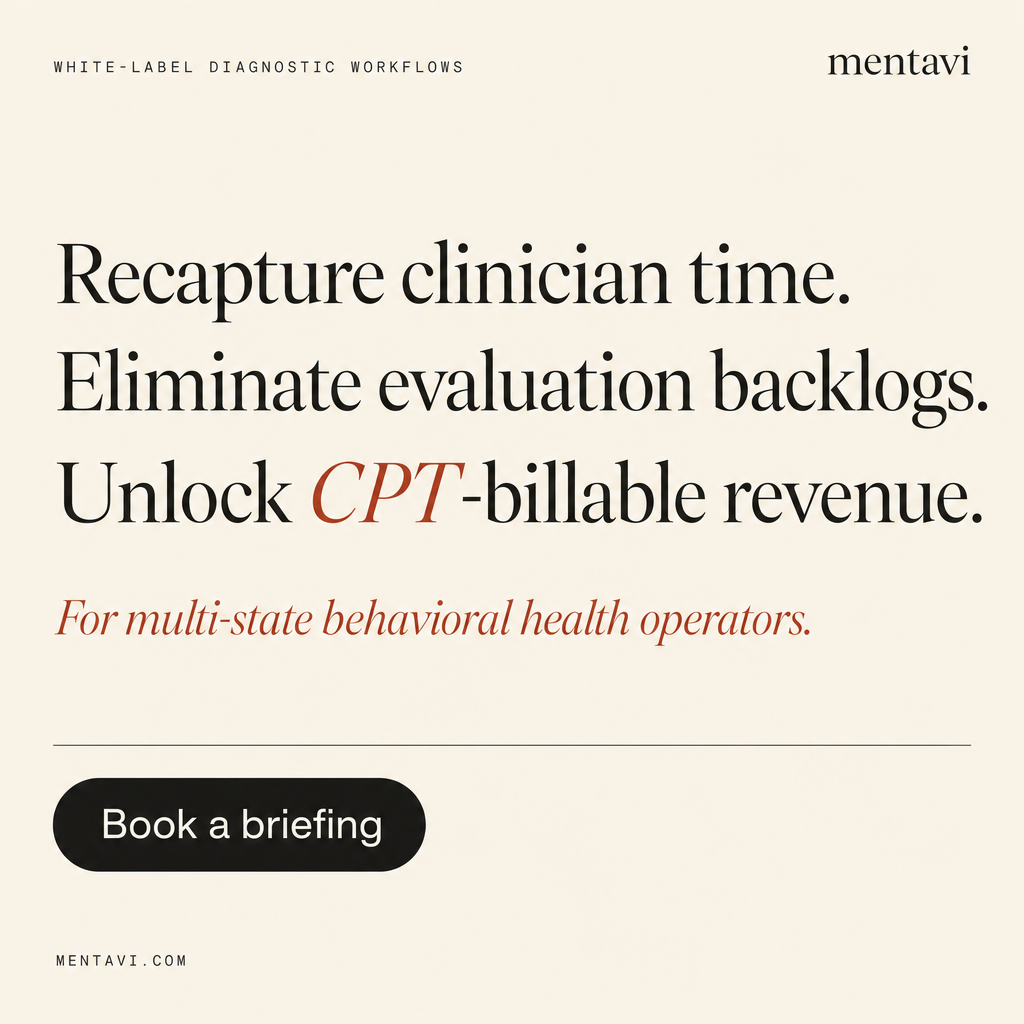
A sample of how the demand engine speaks — six register-defining typographic statements and six lifestyle moments. Three of each for the adult who needs a diagnostic answer; three of each for the operator who needs the diagnostic infrastructure. Identity-neutral, claim-free, every word baked into the frame the way Mentavi's clinical voice asks for it.
Six concepts, two registers, one consistent voice. The point is to show what AYMI's creative-led demand engine sounds like in Mentavi's frame — not to ship a launch.
Adults search differently depending on where they are in the process. The first concept meets the "what is this even" reader. The second names the overlap problem head-on. The third trades urgency for clarity — the calm "5-day answer" promise.

Angle. Permission to evaluate before committing to a course of care. The wedge for the adult who almost made a doctor's appointment, almost started SSRIs, almost guessed. The $199 price and 5-day promise sit at the foot, never at the top.

Angle. The most under-claimed truth in adult mental health, plainly named. Particularly strong for the reader who has tried one treatment for one condition and is wondering why nothing landed. Speaks Mentavi's 29-condition screening surface without ever saying "29 conditions."

Angle. Calm certainty against a six-month specialist waitlist. The five-day promise is the rare numeric Mentavi can stand behind without claiming an outcome. "Anywhere in the US" implicates the national clinical network without naming it.

The B2B reader doesn't need to be sold — they need to be reassured that the rigor is real. Each concept here is an instrument of trust the operator can forward upward without flinching.

Angle. Three rare credentials, stacked plainly. Every word is a brand fact — not a marketing claim. The implicit promise is the one a clinical director wants: "I can defend this in front of my medical board."

Angle. Corey's own LinkedIn framing, productized. Names the category Mentavi is actually building (and that the EHR vendors are not). The operator who reads this either understands instantly or needs a five-minute call to understand — both are good outcomes.

Angle. Three operator-language outcomes, ordered by who in the org first nods. The COO nods at line one. The clinical director nods at line two. The CFO nods at line three. CPT in italic rust is the wedge that converted Corey — built directly back into the creative.
Where the typographic register names the question, the lifestyle register shows the moment. A desk at end-of-day. A laptop in the small hours. A coffee gone cold beside a half-written list. No people in frame — the environment is the protagonist, and the reader recognizes themselves in it without being told to.

Angle. The end-of-day desk as evidence. A scene the executive-function-strained adult has lived a hundred times — the half-eaten sandwich, the post-its with arrows that didn't quite resolve, the coffee that went cold. The headline names what the scene already says.

Angle. The late-night Google search, made visible. The laptop on the bed, the warm lamp pool, the glass of water on the nightstand — the scene every adult who has wondered "is this me or is this something else" recognizes instantly. The headline doesn't moralize the moment; it just names it.

Angle. The kitchen counter in morning light, the spiral notebook full of half-completed bullet points, the coffee gone cold. The wedge for the reader who has tried every "just try harder" explanation and is starting to suspect there's a name for it. Calm certainty against years of self-blame.
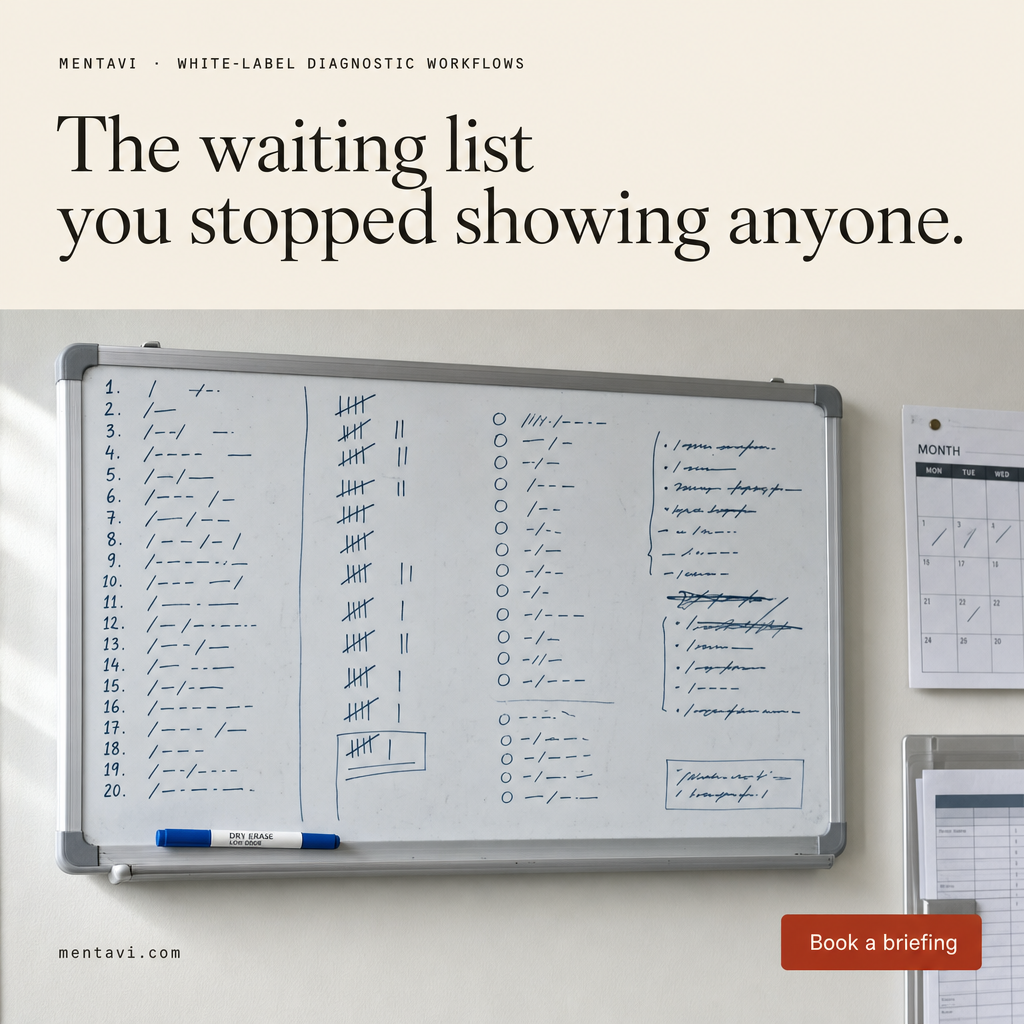
Behavioral health operators don't need to be told the eval backlog exists — they can see it from the doorway. The B2B lifestyle frames mirror what's already real in the practice: the folders piled up, the waiting list nobody publishes anymore, the workstation where the CPT codes aren't being captured. The headline names what the room already says.

Angle. The eval backlog as physical object. Manila folders stacked on a wooden desk, more piled on the floor, the empty chair pushed back at end-of-day. The story every clinical director has lived; the headline names it without dramatizing it.

Angle. The staff-room whiteboard. Abstract handwritten entries, slashes and tally marks, crossed-off lines and notes — recognizable as a waiting list, but no readable names (privacy-respecting by design). The wedge: the reality that's too long to publish on the website but visible in the staff room every day.

Angle. The workstation where the revenue line item lives or dies. EHR monitor angled toward the viewer, stack of forms, pen across the top. CPT italicized in rust accent — the wedge that originally converted Corey, baked into the lifestyle register as well. The CFO sees the unbilled codes before the clinical director does; this is the ad for both.
Once a winner is named, each concept extends into a four-placement set with copy variants and a matched lander block — the production volume the dashboard will read against in the first 60 days.
Twelve concept tiles say something about register and range. The proposal says how the engine actually runs.
Read alongside the full proposal — the five-layer demand engine, the dual-motion KPI map (cost-per-completed-evaluation on D2C, cost-per-qualified-discovery-call on B2B), the Growth System recommendation, and the first-90-days sprint that turns these concepts into a measured creative bank.
← Back to the Mentavi proposal